
Wanuo Textile in China stores 18,000 totes in 500 square metres of floor. The racking is 12 metres high, and gantries bring each tote down to the operator. That is an ASRS. So is a machine that moves pallets in a freezer, and so is a vending-style cabinet in a parts room. The three have almost nothing in common except the label.
ASRS is a category, not a product, so "do we need one?" is the wrong first question. The useful question is which kind. This article sets out what the term covers, the main families, what height really buys you and where an ASRS does not pay. Mushiny's High Density Tote-to-Person system (MIX Pro) is a gantry ASRS for totes, and it is the example we know best.
What does ASRS actually mean?
ASRS stands for automated storage and retrieval system. A machine puts stock into a storage location and takes it out again, and software tells it which location. The operator does not walk to the stock, and nobody drives a forklift to reach it.
Every ASRS has three parts:
- Storage structure. Racking, shelving or a grid, built for the machine that serves it.
- A retrieval machine. A crane, shuttle, gantry, lift or robot that moves the load.
- Control software. It tracks every location and decides what moves next.
That definition is deliberately wide. It covers a crane serving a pallet aisle, a shuttle in a freezer, a gantry handling totes and a grid of robot-served bins. Suppliers also draw the boundary in different places. Some count robots that carry whole shelves to a picker. Others do not, because those shelves stand on open floor rather than in fixed racking. Neither side is wrong. Ask any supplier what they include before you compare quotes.
What are the main families of ASRS?
Most systems fall into one of five families. The table sorts them by what they store and when each is worth a look.
| Family | What it stores | Suits | Watch out for |
|---|---|---|---|
| Unit load (crane) | Full pallets or other large loads | High-volume pallet storage with few SKU changes | A large fixed structure built for the machine |
| Mini load (crane) | Cartons and totes | Medium to large tote counts with steady flow | The crane in each aisle sets the throughput ceiling |
| Shuttle | Pallets or totes, moved by a shuttle on rails in the rack | Deep-lane storage, and sites that want to add capacity in steps | Lifts between levels can limit the peak rate |
| Gantry | Totes, double-deep, served from a gantry above the aisle | Sites short on floor with a tote-suited range | Needs a tote-suited range and a floor that can carry the structure |
| Robotic tote storage | Totes or bins served by robots | Small items at high density | The range must fit the container |
Two more groups sit near the edge of the definition. Carousels and vertical lift modules hold small parts in a cabinet. Robots that carry whole shelves to a picker work without fixed racking. Both are goods-to-person. Whether they count as an ASRS depends on who is selling.
Unit load and mini load
Both use a crane that runs along an aisle between two racks. Unit load cranes take pallets. Mini load cranes take cartons and totes. They are the long-established form of ASRS, and they are most at home when flow is high and the range is stable. The crane is also the limit. One crane per aisle means one retrieval at a time in that aisle.
Shuttle systems
A shuttle is a low vehicle that runs on rails inside the rack and carries a load into deep lanes. A four-way shuttle changes lane on its own, so it reaches any position on its level. Shuttles suit sites that want to add capacity gradually, because you add vehicles without rebuilding the structure. Moving between levels usually needs a lift, and the lifts tend to set the peak rate, not the shuttles. Mushiny's four-way shuttle is not on this site yet. If pallets are your problem, enquire and we will tell you where it stands.
Gantry systems
A gantry runs on rails above the aisle. A handling unit on the gantry lifts the tote out of the rack and passes it to a robot on the floor, which carries it to the workstation. This is how MIX Pro works. It stores totes double-deep in racking up to 12 metres high, with totes 20 mm apart and aisles 900 mm wide. The gantry takes power from a sliding contact line rather than a battery, so it does not stop to charge.
Robotic tote storage
Here robots work a grid or racking of bins, and the density comes from stacking containers rather than from aisles. It suits a range of small items that fit the container.
Where Mushiny's shelf and tote systems fit
MIX 4.0 stores pallets, shelf pods and totes together and presents up to 240 totes an hour at each workstation. Shelf-to-Person carries whole shelf pods to the picker. Both use robots on open floor, so they sit in the grey area above. We call them goods-to-person systems.
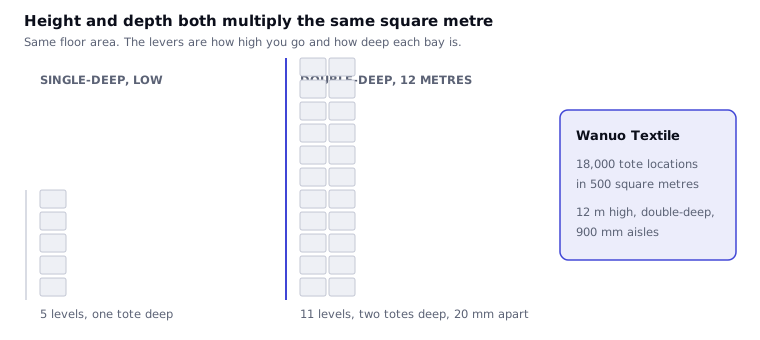
What does the extra height actually buy you?
Height lets you store more in the floor you already pay for. MIX Pro is the clearest case. Wanuo Textile needed high storage in a small footprint, and the result is 18,000 tote locations in 500 square metres at 12 metres high.
Three things turn height into density rather than just tall racking:
- Tight tote spacing. MIX Pro leaves 20 mm between totes.
- Narrow aisles. MIX Pro runs aisles at 900 mm.
- Double-deep bays. Two totes per bay face halves the aisles you need.
Height also costs you. A 12 metre structure is a building project, not an equipment install, and a taller rack means a longer trip for every retrieval. Throughput comes from how many gantries and transfer robots work the aisle, not from how tall the rack is. On MIX Pro a single aisle can carry more than one gantry, so you raise throughput by adding gantries and robots rather than rebuilding the racking.
Haoyan Electronics shows the same system at a smaller scale. The site runs 2 gantries and 3,000 totes, with 5 F50A robots on the floor and 50 kg totes weighed on the way in and out.
When is an ASRS the right call?
An ASRS earns its place when floor space is what you are short of and the stock suits the machine.
Your building is full and you cannot extend it. Height is the one dimension you still have. A dense tote store gives floor back.
Your range is regular. Totes, cartons or pallets of known sizes are what these machines handle best. One family of container keeps the machine simple.
You pick the same stock repeatedly. The software tracks every location, so accuracy stops depending on someone remembering where things are.
Your need is long term. The structure is built for the machine, so the investment pays back over years, not months.
When is an ASRS the wrong answer?
Your constraint is not storage. If pickers walk too far, a goods-to-person system may fix it without a fixed structure. If orders pile up at packing, storage is not the problem.
Your range does not fit the container. MIX Pro takes a 600 x 400 mm tote with customisable height, at up to 50 kg. Stock outside what your chosen system handles stays on a manual line. A flexible gripper can store cartons, totes or trays of variable footprint, so ask before you rule it out.
You expect to move or change the building. A fixed structure built for one machine is hard to relocate. If your lease or your layout is uncertain, a floor-based robot system is easier to change.
Your volume is small. Some systems start small. Alloys runs 5 shelf-to-person robots against 100 pods. A full-height gantry store is a larger commitment, and the arithmetic improves with each shift it works.
How do you work out which kind you need?
Pull these numbers from your own warehouse system:
- Units in storage, by container type. Pallets, cartons, totes and loose items point to different families.
- Item dimensions and weight at both extremes. Check your largest and heaviest regular line against the container.
- Lines per day and peak lines per hour. Peak rate decides whether one crane, a shuttle fleet or several gantries will carry it.
- Usable building height. Allow for sprinklers, lighting and the structure itself.
- Where the time goes today. Walking, waiting at pack and searching for stock each point somewhere different.
- Growth over the next five years. It decides whether you want a system you can extend in steps.
Mushiny sizes storage and speed together, because they have to match. Enough pods and too few robots leaves orders queuing. Enough robots and too few pods leaves nowhere to put stock. You can see the systems running at the Chatswood Tech Centre, the only place in Australia with the full Mushiny range live under one roof. It is free to visit, and you can bring your own product. See the reference sites for named installations, or enquire to book a visit.
Frequently asked questions
What does ASRS stand for?
ASRS stands for automated storage and retrieval system. It is any arrangement where a machine places stock into storage and retrieves it again under software control, so people do not walk to the stock or drive a forklift to reach it. The term covers cranes, shuttles, gantries and robot-served grids, which differ widely in what they store and what they cost.
What are the main types of ASRS?
The main families are unit load cranes for pallets, mini load cranes for cartons and totes, shuttle systems for deep-lane storage, gantry systems for totes and robotic tote storage for small items. Carousels, vertical lift modules and shelf-carrying robots sit at the edge of the definition. The right family depends on the container, the range and the throughput you need.
How high can an ASRS store?
It depends on the family and the building. Mushiny's MIX Pro gantry system stores totes double-deep in racking up to 12 metres high, with totes 20 mm apart and aisles 900 mm wide. Wanuo Textile in China holds 18,000 tote locations in 500 square metres at that height. A taller rack also means a longer trip for each retrieval, so throughput depends on how many gantries and robots serve the aisle.
Is an ASRS the same as goods-to-person?
No, though they overlap. Goods-to-person describes how stock reaches the picker, and an ASRS describes how stock is stored and retrieved. A gantry ASRS such as MIX Pro is also goods-to-person because it delivers totes to a workstation. A robot that carries a whole shelf to a picker is goods-to-person, and some suppliers call it an ASRS while others do not.
Can a small warehouse use an ASRS?
Sometimes. A full-height gantry or crane store is a larger commitment, and the case is strongest when floor space is the constraint. Robot-based goods-to-person systems start smaller. Alloys runs 5 robots against 100 pods, and Munro Footwear Group runs 205 against 5,239. If you are unsure which scale suits you, bring your stock and order data to the Chatswood Tech Centre.
Bring your numbers
Send your order lines and your product dimensions to our engineers. We will work the maths out for you and give you the benefits case laid over your whole operation.
Talk to us →