
Munro Footwear Group in Melbourne picks from 5,239 shelf pods using 205 Mushiny T-series robots. Nobody walks to a pod. A robot drives under the one that holds the stock, lifts it, and carries it to a picker. Those robots are autonomous mobile robots, or AMRs, and that job is what most of them do in a warehouse.
This article explains what an AMR is, how it differs from a robot that follows a fixed path, what it does in a shelf-to-person operation, and what it cannot do. It also shows how fleets scale, using the numbers from real Australian sites.
What is an AMR?
An AMR is a robot that decides its own route at run time. It is given a destination, not a path. Nobody drives it, and no wire or magnetic strip in the floor tells it where to go.
That is the whole definition, and it is worth being precise about what it does not say. It does not say the robot must handle a chaotic environment, and it does not say every AMR localises the same way. Those two choices are where the real engineering sits, and most articles on this subject skip them.
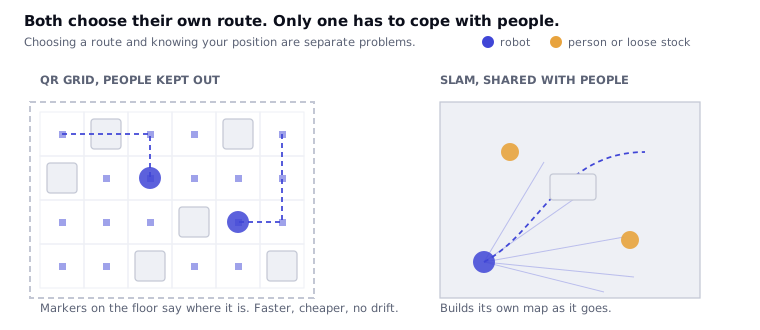
QR navigation and SLAM navigation
Mushiny builds two kinds of AMR, and they solve different problems.
Grid robots navigate by QR code. The floor carries a grid of QR markers. The robot reads them as it travels and knows exactly where it is, to the millimetre. It still chooses its own route across that grid and it still negotiates with the other robots around it, but it works inside a fenced area that people are kept out of. The obstacles it plans around are a known, fixed set: the racking, the pods, and the other robots.
SLAM robots build their own map. SLAM stands for simultaneous localisation and mapping. The robot scans its surroundings, works out where it is from what it sees, and updates that picture as it goes. It needs that because it works in a space that changes: people walking through, pallets left in aisles, stock staged where it was not yet yesterday.
The instinct is to assume SLAM is the better technology because it is the cleverer one. For a goods-to-person grid it is not.
| QR grid navigation | SLAM navigation | |
|---|---|---|
| How it knows where it is | Reads markers on the floor | Scans surroundings and matches a map it builds |
| Accuracy | Higher, and it does not drift | Good, but it depends on what it can see |
| Speed | Faster, because position is certain | Slower, because the robot keeps checking |
| Cost per robot | Lower | Higher |
| Needs people kept out | Yes | No, it is built to share space |
| Copes with a changing layout | The grid is the layout | Yes, that is the point of it |
| Where Mushiny uses it | Shelf-to-person, MIX 4.0, MIX Pro transfer robots | Standalone transport in live, shared areas |
QR navigation is faster, cheaper and more accurate than SLAM. The trade is that it only works where you can isolate the robots from operators, which is exactly what a goods-to-person grid does: the people stand at workstations on the outside and the stock comes to them.
So the question is not which navigation is more advanced. It is whether the robots can have the floor to themselves. If they can, QR wins on every axis that matters. If they cannot, you need SLAM, and you pay for it in speed, cost and precision.
What is the difference between an AMR and a robot on a fixed path?
A fixed-path robot, usually called an AGV, follows a route that was set when it was installed. That might be a magnetic strip, a wire or a painted line. It does one route well. When something blocks that route, it stops and waits.
Both Mushiny variants differ from that, and the difference is not about the floor markings. A QR marker is not a track. It tells the robot where it is, not where to go. The route across the grid is still worked out on the day, by the robot and the fleet manager together.
| Question | Fixed-path AGV | Mushiny grid AMR | SLAM AMR |
|---|---|---|---|
| Who chooses the route? | Set at install | The robot, at run time | The robot, at run time |
| What does the floor tell it? | Where to go | Where it is | Nothing |
| What if another robot is in the way? | It waits | They negotiate and route around each other | It routes around |
| What about a pallet left in the aisle? | It waits | People and loose stock are kept out of the grid | It routes around |
| What if you move the racking? | The route is re-laid | The grid is re-laid out and remapped | The map updates |
| What if one robot stops? | A shared route can stall everything behind it | The others keep working | The others keep working |
One honest note on the term. Not everyone draws the AMR line in the same place, and some vendors call any lifting robot an AMR. If a robot is handed a destination and works out the route itself, it is an AMR, whatever it reads off the floor to locate itself.
What does an AMR do in a goods-to-person warehouse?
In a goods-to-person warehouse the stock comes to the picker. The AMR is how it gets there.
Half of a picker's time in a manual warehouse goes on walking rather than picking. A shelf-to-person system removes the walking. Here is the cycle.
- An order arrives from your warehouse management system.
- The system works out which pod holds the stock and which robot should fetch it.
- The robot drives under the pod and lifts it. Pods stand up to 2.7 metres, so the robot is carrying a full-height shelf and not a tray.
- It carries the pod to a picking station and presents it to the picker.
- The picker takes the item and puts it into the order.
- The robot returns the pod to the floor, or goes straight to its next job.
The robot never picks. A person does, at a station, and the robot's job is to keep that person busy. Mushiny puts the gain at up to four times the picking rate, measured against manual pick-and-walk lines per hour. Treat four times as the top of the range. The gain is largest where pickers currently cover long distances and smallest where the pick face is already dense and compact.
Pods do more than get carried. Standing 2.7 metres tall, they add around 20 per cent more storage on the same floor, and they hold small items and bulky ones in the same system.
The same robots work other formats. In MIX 4.0, a T6 series AMR lifts a pod of totes and carries it to a workstation. The workstation takes the tote the order needs off the pod and presents it to the picker, at up to 240 totes an hour. In MIX Pro, a gantry takes totes from racking up to 12 metres high, and tote transfer robots carry them across the floor to the workstation.
What can an AMR not do?
An AMR carries things. These are the jobs it leaves to other equipment and to people.
It does not pick. The picker at the station takes each item. If picking labour is your constraint, an AMR system changes how much each picker gets done. It does not remove the picker.
It does not sort. Picking many orders in one run leaves a mixed container that has to be split back into orders. That is a different machine. The Minisorter and the 3D Sorter MAX do that job, and it is common to size picking and sortation separately.
It does not pack. A bagging machine such as the PolyPacker does that, at up to 1,500 bags an hour.
It does not help much where walking is not the problem. If your pickers are standing still and your pack bench has a queue, a fleet of robots will feed that queue faster and not remove it. Measure where the time goes before you size anything.
It does not fix bad stock data. Robots go where the software tells them. A location the system has wrong still sends a robot to fetch the wrong thing.
It is not the only way to get density. An AMR system fills the floor with pods. If your constraint is height and your stock suits totes, MIX Pro stores to 12 metres, which is a different answer to a different question.
How does an AMR fleet scale?
You add robots and pods as volume grows, so you buy for the business you have now. The sites below show how wide the range is.
| Site | Robots | Pods | Use |
|---|---|---|---|
| Alloys, Australia | 5 T6-800 | 100 | Technology distribution |
| Coca-Cola, Sydney | 16 T-series | 114 | Spare parts |
| Winc, Sydney | 107 T-series | 1,421 shelf and pallet pods | Workplace supplies, pick and pack |
| Munro Footwear Group, Melbourne | 205 T-series | 5,239 shelf pods | Ecommerce and retail to more than 290 stores |
Alloys runs five robots. Munro runs 205. It is the same system, sized to the operation, so starting small does not mean starting again later.
Other sites show different mixes. Monde Nissin runs 44 T6-1200 AMRs for chilled and ambient stock, with sequenced picking. Full Beauty Brands in Indianapolis finished a system in June 2025 with 21 AMRs and 592 pods.
Divide pods by robots and the ratio moves a long way. It is about 7 pods per robot at Coca-Cola, 13 at Winc, 20 at Alloys, 26 at Munro and 28 at Full Beauty. So the robot count is not a fixed multiple of the pod count. Storage and speed get sized together. Enough pods and too few robots, and orders queue. Enough robots and too few pods, and you run out of places to put stock. Being sized on only one of the two is the usual reason these systems disappoint.
A fleet that fails gracefully is also easier to grow. The robots act as a swarm, so if one drops out the others continue. There are no bottlenecks and no single point of failure, and Mushiny runs a 24/7 service hotline.
What does an Australian site actually see?
Four things, based on the reference sites.
It goes into the building you have. Most Mushiny systems are brownfield. Goods-to-person deployments are typically commissioned in phases, and several Australian sites have gone live over a single weekend with no interruption to daily dispatch. Taitung in Sydney did exactly that, with freezer-rated automation.
The range is wider than people assume. Footwear at Munro, office supplies at Winc, spare parts at Coca-Cola, chilled and ambient food at Monde Nissin and frozen food at Taitung all run on this kind of system. Mushiny has worked with businesses with five or fewer people in their current operation.
It connects to your systems and does not replace them. The robots take their jobs from your warehouse management and order systems. Integration and support are part of the engagement.
You can see it before you commit. The Chatswood Tech Centre is the only place in Australia with Mushiny's full technology range running live under one roof. You can run your own product through it, and it is free to visit. Enquire here, and see the full list of live sites on the references page.
How do you know if an AMR system suits your warehouse?
Start with where the time goes. Walk the floor for one shift with a stopwatch. If pickers are walking, an AMR system is a candidate. If they are waiting at pack, it is not. Then bring your lines per picker per hour, your SKU range and your peak picks per hour to a conversation. Leave the data analysis to us.
Frequently asked questions
What is the difference between an AMR and an AGV?
An AGV follows a fixed route such as a wire, a magnetic strip or a painted line, and it stops when the route is blocked. An AMR decides its own route across open floor and drives around obstacles. Mushiny's shelf-to-person robots work this way. They have no fixed track and no conveyor, so one robot stopping does not stop the others.
How many robots does a warehouse need?
It depends on throughput as well as storage, so it cannot be read off the number of pods. Alloys runs 5 robots against 100 pods. Winc runs 107 against 1,421, and Munro Footwear Group runs 205 against 5,239. Storage and speed are sized together, using your order and stock data.
Are we too small for AMRs?
No. Alloys runs five robots against 100 pods, and the same system scales to Munro's 205. Mushiny has also worked with businesses with five or fewer people in their current operation. You can start small and add robots and pods as volume grows.
What happens when a robot breaks down?
The others keep working. The robots act as a swarm with no conveyor and no single point of failure, so a robot that is charging or being repaired does not stop the system. Mushiny runs a 24/7 service hotline.
How much faster does picking get with AMRs?
Up to four times, measured against manual pick-and-walk lines per hour. Treat that as the top of the range. The gain comes from removing walking, so it is largest where pickers currently cover long distances and smallest where the pick face is already dense.
Can we install AMRs without stopping despatch?
Usually yes. Most Mushiny systems are brownfield and go into your existing building. They are typically commissioned in phases, and several Australian sites have gone live over a single weekend with no interruption to daily dispatch.
Bring your numbers
Send your order lines and your product dimensions to our engineers. We will work the maths out for you and give you the benefits case laid over your whole operation.
Talk to us →