
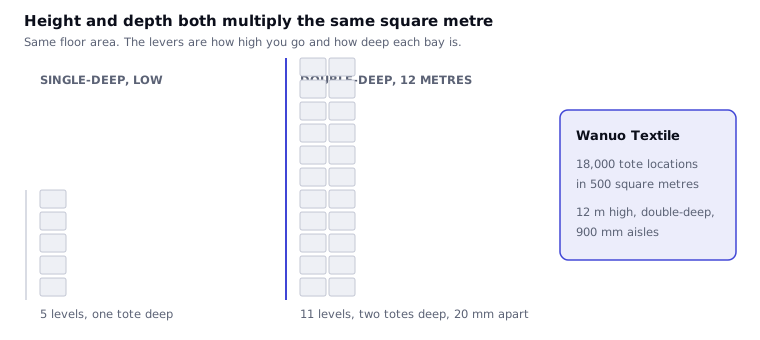
Wanuo Textile in China holds 18,000 tote locations in 500 square metres. The racking is 12 metres high, with multiple cranes working each aisle. Floor area did not set that capacity. Height and depth did. That is the case for the Mushiny MIX Pro, which stores totes double-deep in racking up to 12 metres high.
This article covers what sets density in tote automation, why double-deep storage matters, how 12 metres compares with the published height of an AutoStore grid, and what going tall costs you. Height is not free. It needs a building that can take it, and it adds lift time to every retrieval.
What sets storage density in a tote system?
Four numbers decide how many totes you fit in a footprint.
Height. Each extra metre of racking adds another level of totes over the same floor. This is the biggest lever, and it is the one the building limits.
Depth. Single-deep bays hold one tote behind the face. Double-deep bays hold two, so one aisle serves twice the storage.
Tote pitch. This is the gap between neighbouring totes. Every millimetre of air around a tote is capacity you paid for and did not use.
Aisle width. The aisle holds no stock. A narrow aisle gives that floor back to storage.
Throughput is a separate question. A dense store that cannot get totes to the operator fast enough has the wrong shape for the job. Density tells you what you can hold. It does not tell you what you can move.
What does MIX Pro do on each lever?
These figures come from the MIX Pro data sheet.
| Lever | MIX Pro | What it does for density |
|---|---|---|
| Racking height | Up to 12 m | Adds levels without adding floor |
| Storage method | Single-deep and double-deep | Double-deep puts two totes in each bay depth |
| Tote spacing | 20 mm | Leaves almost no unused gap between totes |
| Aisle width | 900 mm | Returns most of the aisle to storage |
| Tote size | 600 x 400 mm, customisable height | Sets how many fit on each level |
| Tote load | Up to 50 kg | Lets one tote hold heavy stock |
| Travel speed | 3 m/s horizontal and vertical | Sets how fast a tote comes down |
The data sheet gives these as separate specifications, and they work together. A 12 metre rack with wide aisles and loose tote spacing would be tall and still not dense.
Why does double-deep storage matter?
A single-deep rack needs an aisle for every row of totes. Double-deep halves the number of aisles for the same number of totes. The aisle is the part of the floor that holds nothing, so cutting it matters as much as adding levels.
The cost is access. In a double-deep bay, the tote at the back sits behind the tote at the front. The system has to move the front tote to reach the rear one, so slow-moving stock suits double-deep storage better than a fast mover that you touch every few minutes. MIX Pro supports both single-deep and double-deep bays for that reason. You can mix them across the store according to how often each SKU moves.
Slotting decides whether this works. Put your fast movers in single-deep bays near the operator and your slow movers deep. If you get it wrong, the store is dense but slow.
How high does AutoStore go, and how does that compare?
AutoStore is a cube storage system. Bins stack next to and on top of each other inside a grid, and robots run on the grid. Its published height limits come from AutoStore's own grid FAQ and system pages.
The limit depends on the bin height you choose:
| Bin height | Maximum levels | Stack height | With operating space for robots and service |
|---|---|---|---|
| 220 mm | 26 | 5.8 m | 7.8 m |
| 330 mm | 18 | 6 m | 8 m |
| 425 mm | 14 | 6 m | 8 m |
AutoStore's published material says the grid tops out at about 6 metres of stacked bins, and at 8 metres once you include the operating space for the robots and service. Its bin page lists a maximum stack storage height of 5.9 metres. The AutoStore pages differ slightly from each other, so the exact figure depends on which page you read. The Bin Lift, a separate vertical lift, is listed at up to 16.5 metres. That figure describes the lift, not the grid.
Compare these carefully, because the two figures do not measure the same thing.
- Stack against racking. AutoStore's height is a stack of bins. MIX Pro's height is the height of the racking.
- Different headroom. AutoStore asks for 600 mm of clearance above the grid and recommends a minimum of 2 metres of clear space above it. MIX Pro's 12 metres is the racking height and not the building clear height. Check your own building's clear height before you compare either system.
- Different load. AutoStore lists a limit of 30 kg for all bin sizes. MIX Pro's standard tote takes up to 50 kg.
- Different access. AutoStore bins are reached from the top of the stack. MIX Pro reaches totes from an aisle, with a gantry and a tote handling unit, and offers double-deep bays.
MIX Pro's racking height of up to 12 metres is roughly double AutoStore's published stack of about 6 metres. The gap only helps if your building can use it. A site with a 9 metre clear height cannot build to 12 metres, and in that building the extra rating means nothing.
What does height cost you?
Height is not free. These are the costs.
The building. Racking to 12 metres needs a roof, a slab and a structure that can carry it. If you are leasing, the clear height of the building sets your limit before any automation decision does. Check it first.
Certification and fire. Tall racking brings structural certification and fire protection requirements. The rules depend on the building, the stock and the local authority, and they sit outside the automation supplier's scope. Raise them at the start of the project and not at the end.
Lift time. A tote at the top of a 12 metre rack takes longer to reach the operator than one at the bottom. At the MIX Pro travel speed of 3 m/s and acceleration of 1.5 m/s², a 12 metre vertical move takes about 6 seconds of pure travel. That is our own arithmetic on the data sheet figures. It excludes tote handling and queuing, so treat it as a floor.
Throughput per aisle. One gantry serves one aisle at a time. A single aisle supports more than one gantry, and the system dispatches across them. Wanuo runs multiple cranes per aisle for that reason. You raise throughput by adding gantries and tote transfer robots, and you do not need to rebuild the racking.
Concentration of risk. A tall store holds a lot of stock in a small area. Plan maintenance access and recovery, because a fault in a dense aisle affects more stock than a fault in a shallow one.
When is a tall, dense store the wrong answer?
It does not pay in these cases.
Your building is low. Height is the lever MIX Pro leans on most, and a low building takes it away. A lower-profile system such as MIX 4.0 may fit the building better.
Your floor is cheap and your stock is small. Density is worth what the floor costs you. If land and building are inexpensive and the range is small, a lower, simpler store is easier to run.
Your range is not tote-suited. MIX Pro suits tote-suited ranges. If much of the range is oversized or irregular, a store built around totes will leave stock outside it. MIX 4.0 holds pallets, pods and totes together for that reason.
Your throughput is the constraint. If your problem is order lines per hour and not storage, buy throughput first. A dense store only helps once the stock fits.
How to size a tall tote store
You need five numbers from your own site.
- Usable clear height under the lowest obstruction, in metres, across the area you intend to use.
- Tote locations required, today and at the end of your planning horizon.
- Fast and slow mover split, by SKU, so you can decide what goes single-deep and what goes double-deep.
- Peak retrievals per hour, which tells you how many gantries each aisle needs.
- Tote and load profile, including the heaviest regular line against the 50 kg tote load.
Bring these to the Chatswood Tech Centre, or look at the reference sites to see how other sites sized theirs. Wanuo is the one to read for 12 metre racking.
Frequently asked questions
How high can tote automation go?
It depends on the system. Mushiny MIX Pro stores totes in racking up to 12 metres high, double-deep, with 20 mm between totes and 900 mm aisles. AutoStore's published material gives a grid of about 6 metres of stacked bins, and 8 metres including operating space for the robots and service. The building you have sets the real limit.
What is the maximum height of an AutoStore grid?
AutoStore's grid FAQ gives 18 levels of 330 mm bins or 14 levels of 425 mm bins, totalling 6 metres, and 26 levels of 220 mm bins, totalling 5.8 metres. With operating space for the robots and service, it gives a maximum total height of 8 metres, or 7.8 metres for the 220 mm configuration. The Bin Lift is listed separately at up to 16.5 metres.
Why does double-deep storage increase density?
Double-deep bays hold two totes in depth, so one aisle serves twice the storage of a single-deep rack. The aisle holds no stock, so halving the number of aisles returns that floor to storage. The trade-off is that the rear tote is behind the front one, so double-deep suits slower-moving stock better than your fastest lines.
Does taller racking slow down retrieval?
Yes. A tote at the top of the rack travels further than one at the bottom. At 3 m/s travel and 1.5 m/s² acceleration, a 12 metre move is about 6 seconds of pure travel, before handling. Several gantries can serve one aisle, so you can raise throughput without rebuilding the racking.
What building do I need for 12 metre racking?
You need a clear height that takes the racking, a slab and structure that carry the load, and fire and structural certification for tall storage. The clear height is the first check, since it caps what you can build. Bring the building drawings to the sizing conversation.
How many totes fit in a small footprint?
Wanuo Textile in China holds 18,000 tote locations in 500 square metres, using racking up to 12 metres high. Your number depends on your building height, your tote size and your aisle layout, so size it against your own site and not against a reference.
Bring your numbers
Send your order lines and your product dimensions to our engineers. We will work the maths out for you and give you the benefits case laid over your whole operation.
Talk to us →