
It is hard enough for us to keep up with Mushiny's latest and greatest inventions, and we are the same business. We sell, deploy and support Mushiny's own machines, and we still have to work at knowing the range properly. That is the whole argument of this article. If staying current on a product is difficult for the people who sit next to the people who build it, it is harder for anyone further away.
Mushiny Australia sells, deploys and supports Mushiny's own equipment, from shelf-to-person robots to the Minisorter. Many warehouse automation buyers get a different arrangement: an integrator sells them equipment that somebody else designs and builds. Both models are legitimate and both work. This article sets out what the distance between a seller and the product costs a buyer, and then, because we are not neutral here, where an integrator is the right choice and we are not.
Why does it matter who built the machine?
A warehouse system is not a box that arrives and then sits still. It is software, a robot fleet and a layout that keep changing for as long as the system runs. Your order profile shifts, your range grows, and something in the first six months behaves differently from the drawing.
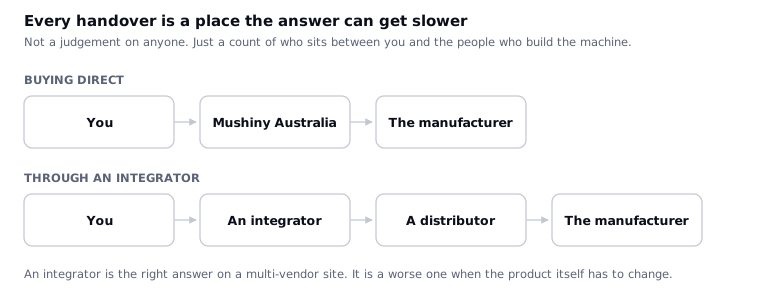
The useful question then is who can change the thing that needs changing. That depends on how many commercial relationships sit between you and the people who made it. We are not saying anyone in the chain is less capable. The point is distance, and distance has costs that do not depend on how good anyone is.
How quickly does product knowledge go stale?
Faster than most buyers expect. A manufacturer revises its machines, its software and its configurations continuously. Mushiny's range alone covers six live solution pages on this site, from pallet, pod and tote storage to a five-machine sorter range running from the Mini at 1,200 to 1,500 items an hour up to the Multi at 30,000 or more, plus a bagging machine, with several robot models underneath them.
Keeping all of that straight is a real job, and we do it from inside the company that builds the range.
An integrator selling equipment from one or more manufacturers has the same job without the same access. It learns about a change when the manufacturer decides to tell it, in the form the manufacturer chooses. The lag is built into the structure. It is not a failing. It is what arm's length means.
Who are you actually talking to when something has to change?
Two kinds of change come up. The first is configuration: changing a sort destination count, re-sizing a pod mix, changing how orders are released to a station. The second is the product itself: a function the software does not have, or behaviour in the machine you need altered.
With a direct relationship, a request about the product can reach the people who own the product without passing through a third party's account manager. With a reseller, the request goes from you to the integrator and then to the manufacturer, and an answer travels back the same way. Each handover is a place for the request to be summarised, delayed or reinterpreted.
An integrator can still be very good at the first kind of change. The second kind is where the distance shows, because the integrator can ask but cannot decide.
Whose roadmap is your site sitting on?
If you buy through a reseller, your site sits on two roadmaps. One is the manufacturer's, which decides what the machine can do next. The other is the integrator's, which decides which products it keeps selling and supporting, and in what priority. Those two do not always point the same way, and you are not party to either.
When the manufacturer builds the machine and also sells it to you, there is one roadmap and one relationship. Your site's needs reach the people deciding what to build through fewer steps. We do not claim that buying direct guarantees the feature you want gets built. It does not. It means you are asking the right people rather than asking someone to ask them.
Where does the margin go when a third party sits in the middle?
We have no data on what any integrator charges and we are not going to pretend we do. We can only talk about structure.
When two businesses stand between a machine and the customer, both need to be paid for their part, and the buyer pays for that arrangement in some form, whether in price, in scope or in what is left out. An integrator does real work, such as design, installation, integration and project management, and that work is worth paying for. The point is only that a buyer should know which party is doing which job. That is a fair question to ask of us as well.
Who owns the problem when a system underperforms?
This is where the models differ most. When a system misses its throughput target, the cause might be the machine, the software, the layout, the stock profile, the integration to your WMS or the way people are using it. Working out which one is the job.
If the same company sold, built and supports the system, there is one party to ask and nobody else to point at. Mushiny's homepage puts it this way: we design, deploy and support the whole system, and integration and ongoing support are part of the engagement.
With a reseller, there are at least two parties that can reasonably say the problem lies on the other side of the line. Both may be right some of the time. The buyer is the one who has to sort it out, usually while the system is underperforming.
What does the difference look like side by side?
| What a buyer cares about | Buying from the manufacturer | Buying through an integrator |
|---|---|---|
| Who changes the software | The company that owns the product | The manufacturer, on the integrator's request |
| Whose roadmap your site sits on | One, the manufacturer's | Two, the manufacturer's and the integrator's |
| Who answers at 6am | The supplier that built the system. Mushiny runs a 24/7 service hotline | The integrator's support, which may escalate to the manufacturer |
| How fast a fix reaches your site | Fewer handovers between the fix and you | Depends on the integrator's relationship with the manufacturer |
| Who carries the risk if it underperforms | One party for the whole system | Shared across parties, split by contract |
| Breadth across brands | Limited to one manufacturer's range | Can span several manufacturers |
The last row is the one that does not favour a direct purchase, and it is the subject of the next section. The "who answers at 6am" and "fix speed" rows describe structure, not guaranteed response times. Ask any supplier for the real numbers in writing.
When is an integrator the right choice?
Often. An integrator is the better answer in each of these cases.
Your site runs several vendors' systems. If the building already runs three other systems, someone has to make them behave as one. An integrator whose job is to work across brands is built for that, and a single manufacturer is not.
You want one party to hold the whole project. Some buyers want a single contract and a single throat to choke across every brand on the floor. An integrator can take that role in a way a manufacturer of one slice of the system cannot.
The package spans things nobody makes end to end. Conveyor, racking, controls and software together are rarely made by one company. Someone has to assemble them into one system. That is real engineering work, and it is the integrator's trade.
You need a vendor-neutral view. If you are not sure which technology suits your operation, a party that sells several can tell you things a manufacturer will not, because it has no single product to defend.
If your project looks like that, an integrator may serve you better than we can. The direct model fits best where the main thing you are buying is one manufacturer's system and you want to be close to the people who make it.
What evidence is there that the direct model delivers?
Our evidence is the reference sites. Mushiny systems run live at Winc in Sydney with 107 T-series AMRs, at Munro Footwear Group in Melbourne with 205 AMRs against 5,239 shelf pods, at Coca-Cola in Sydney with 16 AMRs, at Monde Nissin, Taitung, Alloys and Likewize, and at Future Fulfillment in Melbourne, where a Minisorter runs more than 1,000 units an hour across 100 destinations. Overseas sites include GPA Logistics in the USA, Full Beauty Brands in Indianapolis, and sites in Shanghai and elsewhere in China.
That list shows range and scale. It does not prove every buyer is better off buying direct, and it cannot tell you how those sites would have fared through an integrator.
You can also test the claim in person. The Chatswood Tech Centre runs the full range live under one roof, it is the only place in Australia that does, and visits are free. Ask the people there something awkward about the product and see who answers. Enquire here.
Frequently asked questions
Is it cheaper to buy automation directly from the manufacturer?
We cannot give you a general answer, and nobody should give you one without seeing both quotes. Price depends on scope, site conditions and what each supplier includes. Compare what each quote covers: design, installation, integration and ongoing support.
When should I use an integrator instead of buying direct?
Use an integrator when your site runs several vendors' equipment, when you want one party to hold the whole project across brands, or when the package includes conveyor, racking and controls that no single company makes end to end. A direct purchase suits a project built around one manufacturer's system.
Who supports the system after go-live if I buy from Mushiny Australia?
Mushiny Australia supports the systems it deploys, and Mushiny runs a 24/7 service hotline. Integration and ongoing support are part of the engagement, as set out on the Mushiny homepage. Ask for support terms in writing with any quote.
Does buying direct mean I am locked into one manufacturer?
For the system you buy, you are working with one manufacturer's equipment, and that is a real limit. An integrator can mix brands in a way a single manufacturer will not. If you expect to add other makers' equipment later, raise it early. Mushiny's systems connect to WMS, WCS, ERP and MES platforms rather than replacing them.
Bring your numbers
Send your order lines and your product dimensions to our engineers. We will work the maths out for you and give you the benefits case laid over your whole operation.
Talk to us →