
The short versionCluster picking puts one tote per order on a trolley, so you sort while you pick, and the trolley caps the wave at about ten orders. Batch picking throws everything into one container and sorts afterwards, so the cap moves to how many destinations your sorter has. Same walk down the aisle, far more orders riding on it.
The three ways to pick
Future Fulfillment in Melbourne sorts more than 1,000 units an hour across 100 order destinations on a Mushiny Minisorter. Nobody on that site is limited to what fits on a trolley. Pickers collect a large batch of orders in a single run, and the machine splits the batch back into individual orders afterwards.
Mushiny builds two machines for the sortation step: the Minisorter for sites sorting in the low thousands an hour, and the 3D Sorter MAX for sites sorting from 1,000 to 10,000 an hour or more. The picking principle and the software are the same on both. One is simply bigger and faster.
Discrete picking is one order per trip. Walk out, collect that order, walk back. Almost nobody runs this way at volume, because you pay for the whole walk and get one order out of it.
Cluster picking is what most warehouses actually do. A trolley carries eight or ten totes, one per order, and the picker fills them all in one trip. That is already batch picking in miniature, and it works.
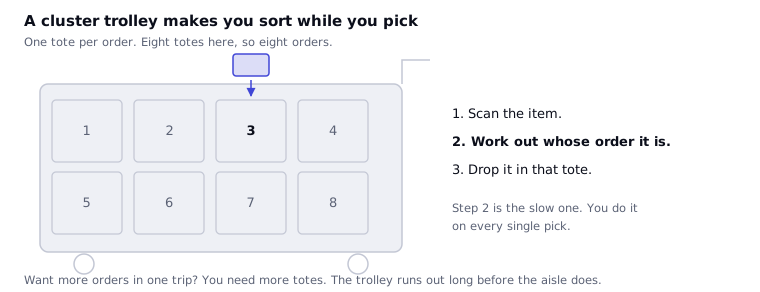
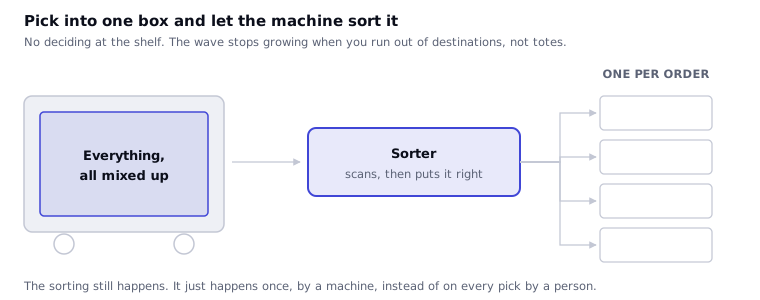
Batch picking answers the obvious question. So why not put a hundred orders on the trolley? Because you would need a hundred totes. That is the whole problem, and it has an obvious fix: take the totes away, throw everything into one box, and sort it afterwards.
The three, side by side
The words get used interchangeably, and they are not the same thing. The difference is when the sorting happens.
| Discrete | Cluster | Batch | |
|---|---|---|---|
| Orders per trip | One | Eight to ten | As many as you have destinations |
| Where the sorting happens | Nowhere, it is already sorted | At the shelf, on every pick | Once, after the walk |
| What you pick into | One container | One tote per order | One container, everything mixed |
| What caps the wave | Nothing, and nothing helps either | Totes on the trolley | Sort destinations, 50 to 400 or more |
| Kit needed | A trolley | A trolley | A putwall or a sorter |
| Decision per pick | None | Which tote does this go in | None |
What a bigger wave buys you
The gain comes from spreading the same walk across more orders, so it is largest where there is a lot of travel to spread. The starting point for most manual sites is that about half of a picker's time goes on non-productive walking rather than picking.
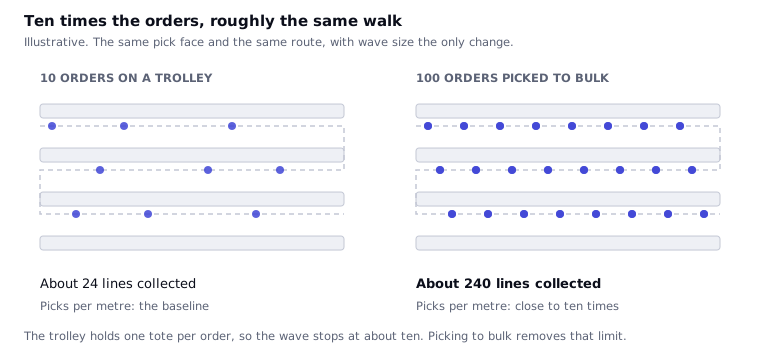
Mushiny puts the effect of larger picking waves at 3 to 5 times on picking and 2 to 3 times on sorting, because a bigger wave raises both the pick rate at the shelf and the number of items collected in a pass.
Jingyuan Supply Chain in Xi'an automated its sortation step. The site tripled its sorting efficiency and cut its picking team from 20 people to 7. The system went live in three days and returned its cost inside a year.
Accuracy also stops depending on concentration, because the putwall is where tired people put the right item in the wrong order and a sorter holds 99.9 per cent however far into the shift it is. Capacity can be added later too: GPA Logistics in the USA doubled their sorter from 80 destinations to 160 after it was running.
Downstream: something still has to sort it
You can do that sorting by hand. A putwall is a rack of pigeonholes: someone reads each item, finds the right slot and puts it in. It is cheap and it works. It also only gets faster if you add people, and a tired person puts the wrong item in the wrong order.
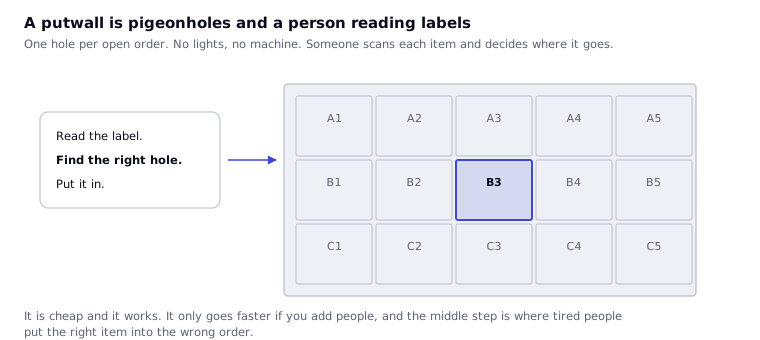
A sorter does the same job at 99.9 per cent accuracy and does not get tired. It also sets your wave size by how many destinations it has, which is a number you buy once rather than a number you staff every shift.
A sorter against a putwall
Putting one ratio on this is harder, and the reason matters. A sorter publishes a rate because the machine sets it. A Minisorter runs 1,200 to 1,500 items an hour from one carrier and two induction ports. A 3D Sorter MAX runs from 1,000 to 10,000 depending on how long you build it.
A putwall publishes nothing, because its rate is whatever the people standing in front of it can do. Add a person and it goes up. That is the actual difference between the two: one scales with capital, the other with headcount, and only one of them keeps scaling after you run out of floor to stand people on.
As a planning figure, call it about 200 units an hour per person on the wall, then time your own before you trust it. At 200, one Minisorter at its published 1,200 to 1,500 is doing the work of six or seven people, and unlike them it is still doing it at four in the afternoon.
| Rate per hour | What sets it | What raises it | |
|---|---|---|---|
| Manual putwall | About 200 per person | Headcount and fatigue | Another person, another wall |
| Minisorter | 1,200 to 1,500 | The machine | A bigger machine |
| 3D Sorter MAX | 1,000 to 10,000+ | Machine length | More length, more induction |
How the sorter works, step by step
The system groups orders into a batch
Your warehouse management system builds a batch out of the open orders, usually grouped around shared SKUs, despatch cut-off or carrier. The number of orders in a batch is capped by the sort destinations downstream, because every order needs somewhere to land.
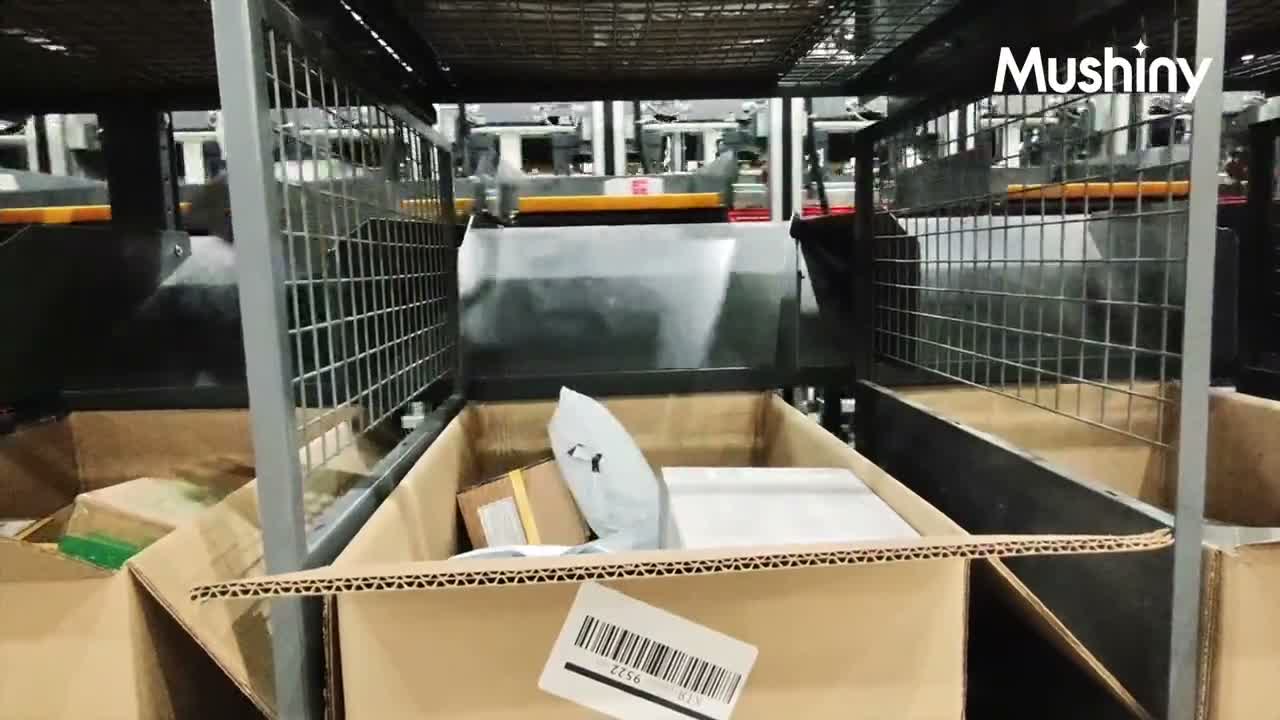
The picker collects the whole batch in one run
A trolley pass collects ten orders. A bulk pass collects as many as the sorter has destinations, over much the same route. On an automated pick face there is no walking at all: shelf-to-person lifts a whole shelf pod and carries it to the station, and MIX 4.0 does it tote by tote at up to 240 presentations an hour per workstation.
Each item is inducted
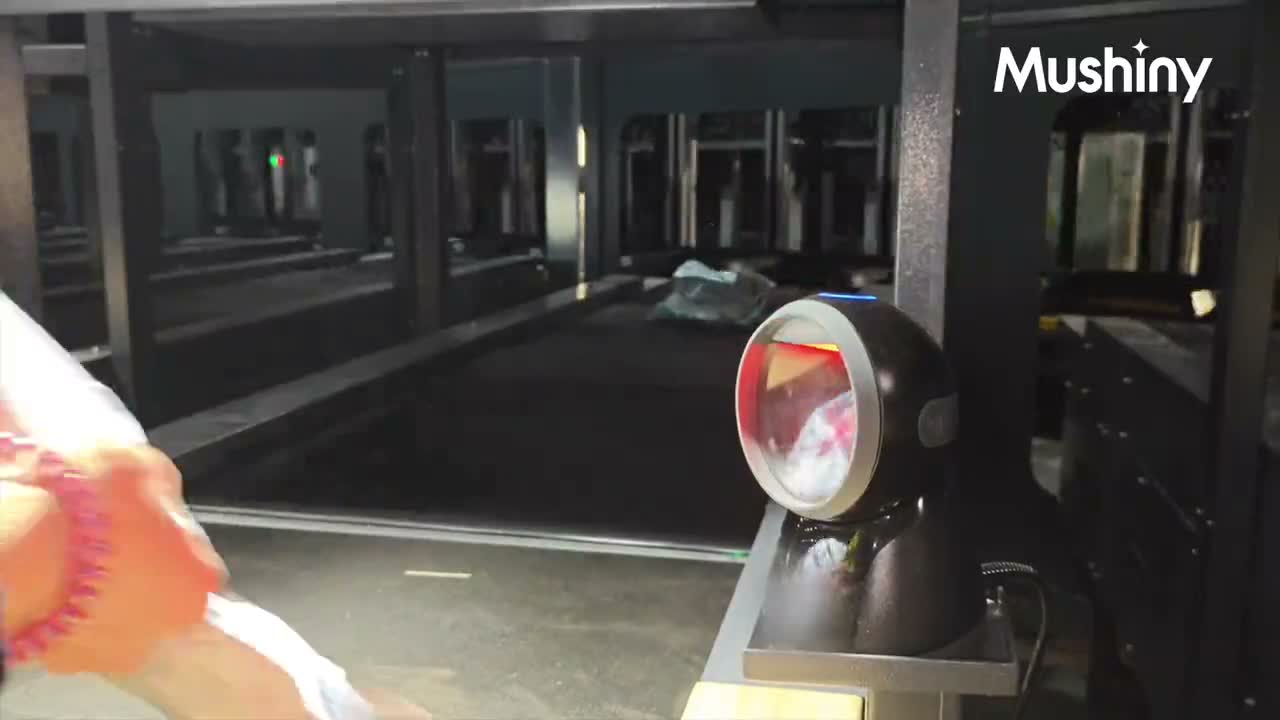
The operator scans the item at an induction port and places it on the machine. That is the entire operator job. A Minisorter runs two induction ports and a 3D Sorter MAX runs up to 10.
The machine carries the item to its order
On the 3D Sorter MAX, linear-motor carts on a 0.5 metre pitch run along a machine that can reach 60 metres. Sorting runs vertically and horizontally at once, so the putwall is a grid rather than a line, which is what holds a high destination count in a given length.
The completed order is cleared
When every line has landed, the destination is emptied and takes the next order. How fast you clear completed orders matters as much as how fast the machine sorts. Downstream, a PolyPacker runs at up to 1,500 bags an hour and keeps packing off the critical path.
When not to do it
Batch picking is a trade. You remove walking and you add a sortation step, so there are operations where the trade does not pay.
Your orders do not share stock. If the orders in a batch rarely contain the same SKUs, the picker still visits nearly as many locations and you have bought a sorter to solve a problem you did not have. SKU overlap across a wave is the first thing to measure, not throughput.
Walking is not actually your constraint. The gain is largest where pickers cover long distances and smallest where the pick face is already dense and compact. If your pickers are standing still and your packing bench has a queue, fix the packing bench.
Your product does not fit the machine. A Minisorter handles items from 50 x 50 x 5 mm up to 750 x 500 x 250 mm depending on the size class, weighing 0.02 to 10 kg. A 3D Sorter MAX handles 50 x 50 x 1 mm up to 450 x 320 x 320 mm, weighing 0.02 to 7 kg. Anything outside that envelope stays on a manual line.
You cannot hold enough orders open at once. On a Minisorter the destination count follows the item size class: 42 to 140 for small items, 30 to 100 for medium and 24 or 48 for large. Need more open orders than that and batches get smaller.
The volume is not there yet. A sorter is a fixed cost and the labour it offsets is a per-shift cost, so the arithmetic improves with every shift you run and gets worse if the machine sits idle. Test it against your own order lines before anyone writes a business case.
What it costs you in floor space
A Minisorter occupies under 25 square metres for one carrier and two induction ports, which is why it suits a site that cannot give up an aisle. A 3D Sorter MAX runs up to 60 metres long, 3,820 mm wide and 2,700 mm high, and because it sorts in three dimensions rather than along a belt it uses up to 50 per cent less floor than a cross-belt sorter. A pharmaceutical site in Europe fits 400 destinations into 150 square metres. Compare those against the floor a manual putwall of the same destination count occupies, including the aisle the operator works in.
On payback, Mushiny's public position is that it depends heavily on how efficient your operation already is, and that after analysis and sizing, goods-to-person and sortation systems typically land under a three year return. Treat that as the shape of the answer. The input that moves it most is your own cost per line.
Where it is running
Sortation earns its keep where orders are small, numerous and unpredictable. These are some of Mushiny's sites.
| Site | Sector | Destinations | Rate per hour |
|---|---|---|---|
| Future Fulfillment, Melbourne | Ecommerce 3PL | 100 | Over 1,000 |
| GPA Logistics, USA | 3PL, apparel to electronics | 160, doubled from 80 | About 2,000 |
| Medical logistics, Shanghai | Medical fulfilment | 50 | Over 1,000 |
| Pharmaceutical site, Europe | Pharma | 400, in 150 square metres | 2,400 |
| Book distributor, China | Books | 400, on a 32 metre machine | 5,000 |
Want to see how batch pick and sort works for you?
Some operations are already batch picking and sorting at a putwall. The maths there is simple. Our sorters are more efficient than manual puts, so the business case usually stacks up.
Some operations are picking discrete or in clusters. The maths there is harder, but increasing the batch size while you pick generally has a large benefit. Send your data to our engineers and we will work the maths out for you, and give you the benefits case laid over your whole operation.
Frequently asked questions
How is this different from cluster picking on a trolley?
It is the same idea with the cap taken off. Cluster picking puts one tote per order on a trolley, so the wave is limited to about ten orders and nothing needs sorting afterwards. Batch picking collects by SKU into bulk, so the wave is limited by sort destinations instead of by trolley space, and the mixed container has to be split back into orders. That splitting step is sortation, done either by hand at a putwall or automatically by a sorter.
How many orders can you put in one batch?
Batch size is capped by the number of sort destinations, because every order needs somewhere to land. A Mushiny Minisorter is configured to the order profile and its destination count follows the item size class: 42 to 140 destinations for small items, 30 to 100 for medium and 24 or 48 for large. On the 3D Sorter MAX the count follows machine length rather than a model number, with machines running up to 60 metres.
How does an automated sorter compare with a manual putwall on accuracy and floor space?
Mushiny rates both the Minisorter and the 3D Sorter MAX at 99.9 per cent sort accuracy, and that rate does not change with how long the shift has been running. A manual putwall depends on an operator reading the correct slot every time, so its error rate rises with fatigue and with slot count. On floor, a Minisorter needs under 25 square metres for one carrier and two induction ports, and a European pharmaceutical site holds 400 destinations in 150 square metres.
What is the payback period on a sortation system in Australia?
Mushiny's public position is that payback depends heavily on how efficient the existing operation is, and that after analysis and sizing, goods-to-person and sortation systems typically land under a three year return. Jingyuan Supply Chain in Xi'an returned the cost of its system inside a year, which is faster than typical and reflects how manual that site was beforehand.
Do we have to replace our WMS to run batch picking?
No. Mushiny's sortation systems integrate with WMS, WCS, ERP and MES rather than replacing them, and they handle reverse logistics as well as outbound flow. Most Mushiny systems are brownfield installations that go into the building you already occupy, and several Australian sites have gone live over a single weekend without interrupting despatch.
Bring your order profile
Item dimensions and the destination count are what size this machine. Bring your order lines and your product dimensions and we will size it against your operation.
Book a tour →