
Munro Footwear Group in Melbourne runs 205 T-series AMRs against 5,239 shelf pods. Alloys runs 5 against 100 pods. Both sites use the same kind of machine, and neither has a track in the floor. That is the practical meaning of AMR, and it decides what you should buy.
This article explains the difference in terms of how the robot chooses its route, because the labels on their own will mislead you. It also covers where a fixed-path machine is still the better answer. If you already know you want robots that bring stock to the picker, start with shelf-to-person and come back here to check the fit.
How do an AMR and an AGV differ?
The difference is who decides the path.
An AGV (automated guided vehicle) follows a route that was set in advance. The guide might be a magnetic strip, a wire in the floor, reflectors on the walls or a laser map. The vehicle drives the route it was given. It does not choose a different one.
An AMR (autonomous mobile robot) is given a destination and works out the route itself. Software coordinates the fleet so the robots do not block each other.
Blocked routes, layout changes, floor work and fleet behaviour all trace back to whether the path is fixed or chosen.
AMR vs AGV at a glance
| AGV | AMR | |
|---|---|---|
| How it navigates | Follows a fixed route set at install | Plans its own route to each destination |
| When another robot is in the way | Usually stops and waits, unless a second route is built in | The fleet negotiates and they route around each other |
| Cost of changing the layout | Re-lay or re-survey the guide path, often with floor work | Change the map and the station positions in software |
| When one vehicle fails | Can block the lane behind it | The others keep working |
| Suits | Stable layouts, one repeated flow, heavy fixed-point moves | Changing layouts, mixed ranges, sites that will grow |
The table describes the two types in general. A particular product can sit between the columns.
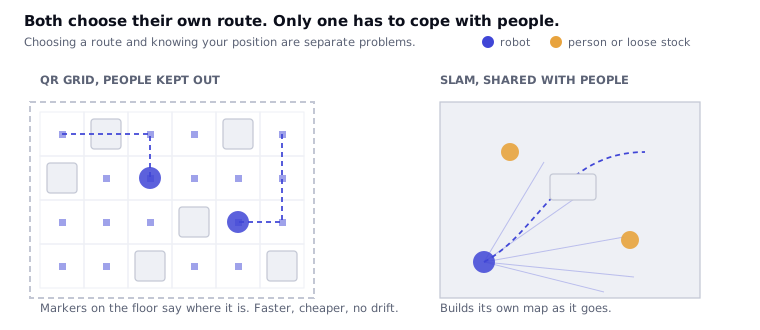
The question that matters more: how does it know where it is?
The AMR and AGV labels get most of the attention, and they are the less useful half of the decision. Two robots can both be AMRs and still be built for completely different jobs, because choosing a route and knowing your position are separate problems.
Mushiny builds both answers.
Grid robots navigate by QR code. The floor carries a grid of QR markers. The robot reads them as it drives and knows its position precisely, without drift. It chooses its own route across that grid and negotiates with the other robots, but it works inside a fenced area that people are kept out of. The things it plans around are a known, fixed set: the racking, the pods and the other robots.
SLAM robots build their own map. The robot scans its surroundings, works out where it is from what it sees, and keeps updating as it goes. That is what you need in a space that changes: people walking through, pallets left in aisles, stock staged somewhere new.
It is tempting to treat SLAM as the superior option because it is the harder problem. Inside a goods-to-person grid it is the wrong tool.
| QR grid navigation | SLAM navigation | |
|---|---|---|
| How it knows where it is | Reads markers on the floor | Scans and matches a map it builds |
| Accuracy | Higher, and it does not drift | Good, but depends on what it can see |
| Speed | Faster, because position is certain | Slower, because it keeps checking |
| Cost per robot | Lower | Higher |
| Needs people kept out | Yes | No, it is built to share space |
| Copes with a changing layout | The grid is the layout | Yes, that is the point |
QR navigation is faster, cheaper and more accurate than SLAM. The trade is that it only works where the robots can be isolated from operators, which is exactly how a goods-to-person grid is built: people stand at workstations around the outside and the stock is brought to them.
A QR marker is not a track. It tells the robot where it is, not where to go, so a grid robot is still choosing its route on the day. Anyone comparing suppliers should ask how the robot localises and whether it is designed to share space with people, because those two answers decide far more than the label on the brochure.
Why do vendors disagree about what an AMR is?
Because the two words describe a spectrum, and the market uses them loosely.
Some AGVs navigate by laser and can be re-mapped in software, which makes them look like AMRs. Some products sold as AMRs follow fixed routes inside a coordinated system. Some articles define the terms by body shape or by price. Others call any robot that moves itself an AMR. Each framing gives a different answer for the same machine.
You can cut through this with three questions for any supplier.
- Does the robot choose its own route at run time, or follow one set at install? This is the test that matters.
- What happens when something blocks the route? Ask for a demonstration, not a description.
- What does it cost, and how long does it take, to change the layout? If the answer involves a survey, a site visit or floor work, the path is fixed, whatever the brochure calls it.
Ignore the label. A robot that picks its route is an AMR in the sense that matters to your operation. A robot that follows one is an AGV.
What does an AMR look like in a warehouse?
In Mushiny's shelf-to-person system, a robot drives under a shelf pod, lifts it and carries it to the picking station. The robots drive on open floor, not a fixed track, so they route around each other. Pods stand up to 2.7 metres and hold small and bulky items together.
There is no conveyor. If one robot is charging or being repaired, the others keep going. You add robots and pods as the business grows, so the layout you start with is not the layout you are stuck with.
Winc runs 107 T-series AMRs and 1,421 shelf and pallet pods. Coca-Cola in Sydney runs 16 against 114 shelf pods for spare parts. Monde Nissin runs 44 T6-1200 AMRs across chilled and ambient stock. Taitung, a frozen and ambient food supplier in Sydney, went live over a single weekend with freezer-rated automation in a brownfield building. All of them are on the reference sites page.
For totes, MIX 4.0 uses a T6 series AMR to lift a whole pod of totes and carry it to a workstation that presents up to 240 totes an hour.
When is an AGV or a fixed-path machine still the right answer?
More often than AMR marketing suggests. A fixed path is a good design when the work is fixed.
One flow that never changes. If you move the same load from the same dock door to the same stretch of racking all day, a fixed route does the job and there is nothing for a robot to decide. You would pay for flexibility and never use it.
A heavy, dedicated lane. Where the load is a full pallet or a very heavy unit moving along a single corridor, a guided vehicle or a conveyor is simple, proven and easy to maintain. Do not buy a fleet to replace a conveyor that works.
A layout that will not move. Some sites are built around a process that stays put for ten years. The cost of changing a guide path only matters if you expect to change it.
Storage where the structure does the guiding. Mushiny's own MIX Pro is an example. A mobile gantry runs on rails above the aisle and stores totes double-deep in racking up to 12 metres high, with totes 20 millimetres apart and aisles of 900 millimetres. The gantry has a fixed path because the density depends on it. The tote transfer robots that carry totes to the workstation travel at ground level with no fixed route. One system uses both ideas, each where it suits.
Fixed paths suit fixed work, and robots that choose their path suit work that varies. Most warehouses have some of each.
What does changing the layout actually cost?
This is where the two types separate most clearly, and where buyers most often underestimate the difference.
With a fixed-path system, a new pick station, a moved aisle or a new product family means changing the route the vehicles follow. That can mean new guide material in the floor, a new survey and a pause in service while the change goes in.
With an AMR system, the route is an output of the software. You move a station, change where pods stand or add a zone, and the robots plan around the change. Adding capacity means adding robots and pods rather than rebuilding a route. Most Mushiny systems are brownfield, and several Australian sites have gone live over a single weekend with no interruption to daily dispatch.
None of this is free. An AMR fleet needs a floor it can drive on, wireless coverage across the working area and a plan for charging. Check your floor before you assume those are zero.
What happens when something blocks the route?
A pallet left in an aisle, a person walking through, a robot that has stopped. On a fixed route, the vehicle waits until the obstruction clears, and everything behind it waits as well.
An AMR plans around the obstruction. If one robot drops out, the rest carry on, because the fleet is not tied to a shared lane. Mushiny describes its robots as acting as a swarm, with no bottlenecks and no single point of failure.
Do not read that as a promise of no downtime. Any machine can break, and the fleet still needs service cover. What changes is that a single fault stops one robot, not a whole lane.
How do you decide between them?
Work through these questions with your own operation in mind.
- How often will the layout change? If rarely, a fixed path costs you little. If every year, price the changes into the comparison.
- How varied is the range? One load type on one route suits a fixed machine. Small items, bulky items and pallets in one building suit robots that go anywhere.
- Will you grow? Adding robots and pods is a smaller step than extending a guided route.
- What does a stoppage cost you? If a stopped vehicle blocks a lane and holds up despatch, the resilience of a fleet is worth money.
- Is the task transport, or is it picking? Moving pallets from A to B is a different job from bringing stock to a picker. For picking, walking is the cost to remove, and Mushiny's shelf-to-person page puts it at about half a picker's time.
- What does your floor look like? Check levels and joints, and any area where robots would share space with people or trucks.
If most of your answers are "rarely, one load, no growth", an AGV or a conveyor may be the cheaper answer. If most go the other way, you are describing an AMR site.
Where can you see the difference for yourself?
The Chatswood Tech Centre is the only place in Australia with Mushiny's full range running live under one roof. It is free to visit. Bring your product and your layout, and watch how the system handles them. Mushiny does the data analysis and right-sizes the solution for your operation.
Frequently asked questions
What is the main difference between an AMR and an AGV?
An AGV follows a path set in advance, such as a magnetic strip, a wire or a laser map. An AMR works out its own route across open floor and replans when something is in the way. Body size, shape and price do not decide which type a robot is. The way it chooses its path does.
Is an AMR better than an AGV?
Not always. An AMR suits a changing layout, a varied range and a site that will grow. An AGV or a conveyor can be the better choice when one load moves along one route that will not change. Test both against how much your own layout and flows vary.
Do AMRs need tracks or guide paths in the floor?
No. Mushiny's shelf-to-person robots drive on open floor, not a fixed track, and they route around each other. Winc runs 107 T-series AMRs and Munro Footwear Group runs 205 this way. You still need a floor the robots can drive on and a plan for charging.
What happens to an AMR system when one robot fails?
The others keep working. The robots act as a swarm, so a failed robot stops itself and not the lane behind it. There is no conveyor to break and no single point of failure. Mushiny backs its systems with a 24/7 service hotline.
Can an AMR system go into a warehouse that is already running?
Yes. Most Mushiny systems are brownfield and drop into your existing building. Several Australian sites have gone live over a single weekend with no interruption to daily dispatch, including Taitung in Sydney with freezer-rated automation.
How big does a site need to be before AMRs make sense?
Smaller than most people expect. Alloys runs 5 T6-800 AMRs against 100 pods and Munro Footwear Group runs 205 against 5,239. It is the same system sized to the operation, so starting small does not mean starting again later.
Bring your numbers
Send your order lines and your product dimensions to our engineers. We will work the maths out for you and give you the benefits case laid over your whole operation.
Talk to us →